The Cost You Can Control: Reducing Unnecessary Moves in Your Network
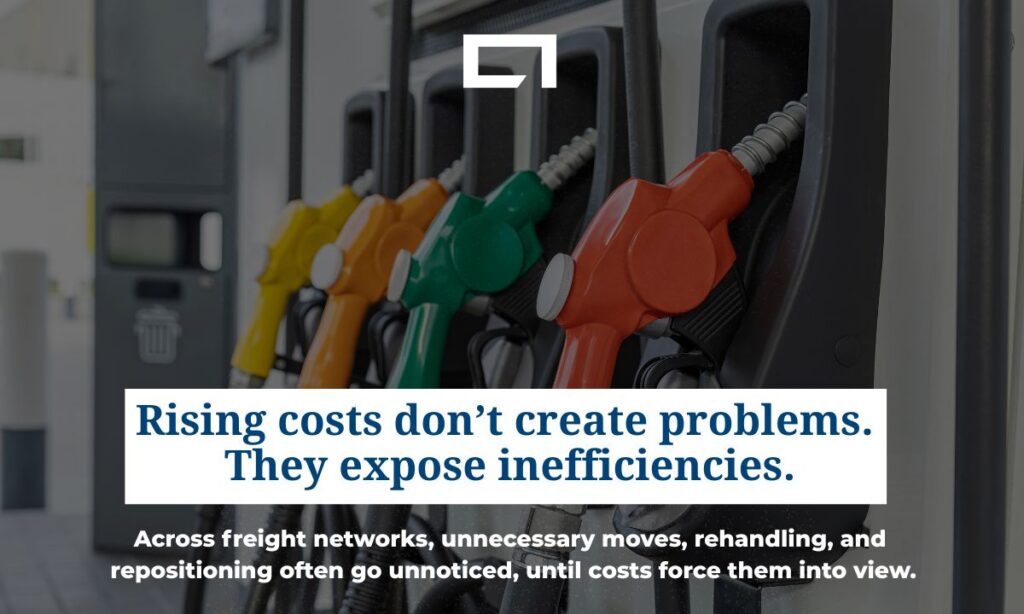
Fuel is getting the headlines lately, but most operators aren’t focused on the number itself. What matters more is how rising transportation costs start to expose inefficiencies that were easier to absorb before.
When costs rise, inefficiencies become harder to ignore
When costs increase, the margin for error shrinks. Moves that once felt routine, repositioning equipment, holding freight in the wrong place, working around congestion, start to carry more weight. Not because anything fundamentally changed in the operation, but because the cost of each decision is higher.
That shift tends to bring the same underlying issue into focus: timing.
Most breakdowns in the network come back to timing
In many cases, supply chains don’t break down because there isn’t enough space. They break down because things aren’t arriving when or where they’re needed. Freight shows up before downstream capacity is available, or too much volume hits at once, or delivery windows move after assets are already in motion. The result is a network that starts reacting instead of flowing.
Reaction creates more movement than the plan ever intended
Once that happens, movement increases. Not necessarily because it’s planned that way, but because there aren’t many other options. Freight gets repositioned, held temporarily, or routed around constraints just to keep things moving. Over time, those adjustments layer on top of each other and create additional cost that isn’t always easy to trace back to a single cause.
Creating space in the network changes how decisions are made
That’s where more deliberate use of storage and staging starts to make a difference.
Instead of forcing freight directly into its next step, some operators are creating flexibility between transportation and final delivery. Giving the network a place to absorb timing mismatches allows decisions to be made based on current conditions rather than fixed assumptions.
Storage becomes more than overflow
Container depots and industrial outdoor storage (IOS) serve that role in a practical way. They provide space to hold containers, trailers, chassis, and equipment close to where they will ultimately be needed, without adding pressure to already constrained facilities. More importantly, they allow operators to slow things down just enough to regain control of timing.
Control comes from having options, not reacting to constraints
That shift is from reacting to conditions to managing them, it’s subtle, but it has a meaningful impact.
When storage is used this way, it stops being just overflow. It becomes part of how the network is managed. It gives operators the ability to reduce unnecessary repositioning, avoid pushing freight into congested environments, and better align movement with actual capacity downstream.
Higher costs don’t create problems, they reveal them
In a lower-cost environment, those kinds of inefficiencies can go relatively unnoticed. There’s enough flexibility in the system to absorb them. But as transportation costs rise, the impact becomes harder to ignore.
That’s why the conversation isn’t really about fuel. It’s about what higher costs reveal.
The goal isn’t less movement, it’s more intentional movement
They highlight how much movement in a network is truly necessary, and how much is happening simply because there aren’t better options in place at the time.
The goal isn’t to eliminate movement. It’s to be more intentional about it.
That often starts by asking a different question: does this need to move right now, or does it need to be positioned correctly for what comes next?
The cost you can control
When operators can make that distinction, the network begins to behave differently. Movement becomes more aligned. Congestion is easier to manage. And the number of reactive decisions starts to decrease. Those are changes that don’t depend on external conditions; they come from how the operation is structured and how decisions are made within it.
Fuel prices will continue to fluctuate. Demand will shift. Capacity will tighten and loosen over time. Those factors are part of the environment.
But how efficiently freight moves through a network, how often it is repositioned, how well timing is managed, and how much flexibility exists between steps, is something operators can influence more directly. In an environment where costs are rising, that becomes one of the most important levers available.
Because in many cases, the most expensive move isn’t the one you planned. It’s the one you didn’t need to make in the first place.